Bitcoins in Space! - IEEE Spectrum
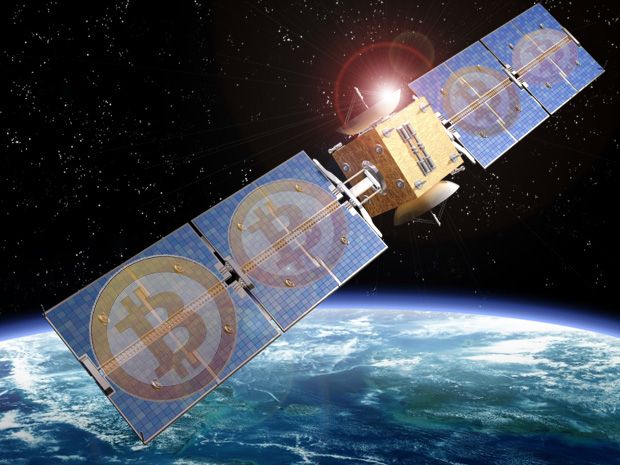
Illustration: Randi Klett; Satellite: iStockphoto
Richard Branson, the brazen Brit behind Virgin Galactic, made news last week when he announced that he has begun processing Bitcoin payments from would-be space tourists. (A woman in Hawaii has already booked her ticket, the company says.) But it turns out Branson’s not the only Bitcoin enthusiast looking toward the heavens. Jeff Garzik, one of the core developers of the Bitcoin software and a new addition to the team of developers at BitPay, a Bitcoin payment processor, has been quietly working on a side project aimed at making Bitcoin work by satellite.
Garzik first hinted at his intentions during his “State of the Coin” address at a Bitcoin conference last year in London, where he briefly mentioned that he was working to launch a satellite that would be paid for in bitcoins. Last month, he announced the full purpose of the satellite. According to Garzik, it will repeatedly transmit the most recent block in the Bitcoin block chain—the latest transaction data processed by the Bitcoin network.
In succession, the block chain represents the entire ledger of Bitcoin transactions. And it’s the task of users—anyone running a Bitcoin client—to both validate the calculations contained in the blocks and to send requests for new transactions to the peer-to-peer network of some 2000 to 5000 machines running the Bitcoin reference software.
“Without the peer-to-peer payment network, Bitcoin does not function today,” explains Garzik. A coordinated, distributed denial-of-service attack on all peer-to-peer nodes would effectively stop all payments across the network, and this is the threat that he wants to address.
“Use of the payment network is not a technical requirement of Bitcoin. If another mechanism for distributing Bitcoin data existed—be it satellite or flash drive via the postal service—then Bitcoin could continue to survive,” says Garzik.
Satellites do have their own vulnerabilities. It’s possible, for example, to disrupt them with a maneuver resembling a denial-of-service attack called double illumination, which simply jams the satellite with signals from overlapping frequencies. If the interference is strong enough, it can effectively cut satellite transmissions.
But Garzik is not looking for a single, foolproof solution. As he describes it, this is more of a move to diversify. “The general idea is the need to find varied means for block-chain data-set distribution,” he says. “We need all the resilience we can muster. Satellite distribution of public block-chain data would facilitate some level of resilience, as well as perhaps enabling use in geographic areas where Internet connectivity is unavailable or spotty.”
For the first phase of the project, Garzik is looking into CubeSats, miniature satellites that weigh only about a kilogram. The most likely scenario would be to hitch a ride on a rocket as a secondary payload. Lockheed Martin, for example, is working on a program that by 2015 would offer ride shares for CubeSats through its Athena launch services.
If he goes this route, Garzik won’t be able to precisely control which orbit the CubeSat ends up in. “Having a network of ground stations is critical to account for multiple orbits that might be achieved,” he says. These stations will then be responsible for transmitting block-chain updates to the satellite.
Garzik estimates that the cost of construction and launch will be about US $2 million and says that if necessary, he will be able to fund the first phase of the project on his own—with bitcoins. But he expects a lot of help. Last week, he set up a Bitcoin address for donations and has already received 25 bitcoins (more than US $20 000) from a group called BitcoinGrant.org.
Although Garzik has not offered a definitive accounting of how this money will be spent, the public nature of the Bitcoin block chain will enable donors to track where their money goes. “My ‘bitcoins in space’ project has a public, trackable donation address,” says Garzik. “If other space partners accept Bitcoin, we are able to disclose and track those purchases as well.”
If the first launch is a success, Garzik intends to follow up with more satellites. “In the short term, there are sufficient people interested in the Bitcoin community that fully funding Phase 1 is assured,” he says. “Based on the same factors and expressed interest, it seems likely that at least one demonstration satellite can be funded and flown in a three- to five-year time frame. Additional interest and funding will dictate how large the network may grow. At worst, listeners may have to wait a few hours to tune in and receive their block-chain broadcast, rather than a fully real-time feed that a cluster of satellites may provide.”
Want to contribute to the project? Here’s Jeff Garzik’s donation address.
Morgen E. Peck is a New York City–based reporter who has been coveringBitcoin and other cryptocurrencies for IEEE Spectrum since 2011.
Advertisement
 Computing
If Senators Really Like Bitcoin They Should Encourage Banks To Cooperate
Senate Hearings on Bitcoin seek to balance regulation with innovation21 Nov
ComputingBitcoin’s Computing Crisis
The computing power of the network that runs Bitcoin doubled in October, pushing out all but the most dedicated (and richest) miners. Could an alternative currency, Litecoin, be the solution?31 Oct
ComputingWho’s Who in Bitcoin: Zerocoin Hero Matthew Green
Bitcoin isn’t as anonymous as you might think, but Zerocoin could make it so24 Oct
ComputingWho’s Who in Bitcoin: Web Payments Wunderkind Manu Sporny
When paying is as easy as clicking “pay” on a website, Bitcoin will be much more valuable16 Sep
ComputingWho’s Who in Bitcoin: Alt-Coin Advocate Dennison Bertram
Bertram suggests that a Bitcoin staging ground is vital to realizing the cryptocurrency’s full potential9 Sep
Advertisement
ComputingHow New Indoor Navigation Systems Will Protect Emergency Responders
Tracking firefighters in blazing buildings helps keep them safe28 Aug
ComputingBitcoin Startup ArtaBit Working On Cheaper Alternative To Western Union
Bitcoin could break into the $400 billion global remittance market7 Aug
ComputingOSI: The Internet That Wasn’t
How TCP/IP eclipsed the Open Systems Interconnection standards to become the global protocol for computer networking30 Jul
ComputingWhy the Internet Needs Cognitive Protocols
Networks will break down without new biologically inspired routing26 Jul
ComputingSEC Charges Texas Man With Running Bitcoin Ponzi Scheme
And the freedom-loving Bitcoin community is welcoming the government's action24 Jul
Advertisement
ComputingEmergency Alert Study Reveals Metadata’s Better Side
Scientific studies of anonymized cellphone-call information find potential public safety benefit24 Jul
ComputingLong-Distance Quantum Cryptography
A hybrid system could secure transmissions over hundreds of kilometers23 Jul
ComputingJaron Lanier: We’re Being Enslaved by Free Information
He says our network architecture is shrinking the economy and impoverishing the middle class16 Jul
ComputingUK Orders Google to Delete Last of Street View Wi-Fi Data
Company escapes fine, says it works hard on privacy, except when it doesn’t24 Jun
ComputingCredit Union: Bitcoin's New Best Friends?
The Internet Archive Credit Union comes to the 2013 Bitcoin conference waving an olive branch22 May
Computing'Strongbox' for Leakers Offers Imperfect Anonymity
Humans still represent the weakest link in a new online tool for anonymous sources20 May
ComputingBitcoin ATM Robocoin Makes Money Laundering Easy
As the Department of Homeland Security targets online Bitcoin exchanges, alternatives are beginning to emerge17 May
ComputingFeeding the World With Big Data
Agriculture experts say that open data could lift people out of poverty14 May
ComputingThe Bitcoin Arms Race Is On!
Powerful mining machines are changing the nature of the popular cryptocurrency6 May
ComputingFace Recognition Failed to Find Boston Bombers
Facial recognition software didn't spot the Boston Marathon bombers; armchair "investigators" found too much23 Apr